Swedish Greetings & Everyday Phrases — The Essential Guide
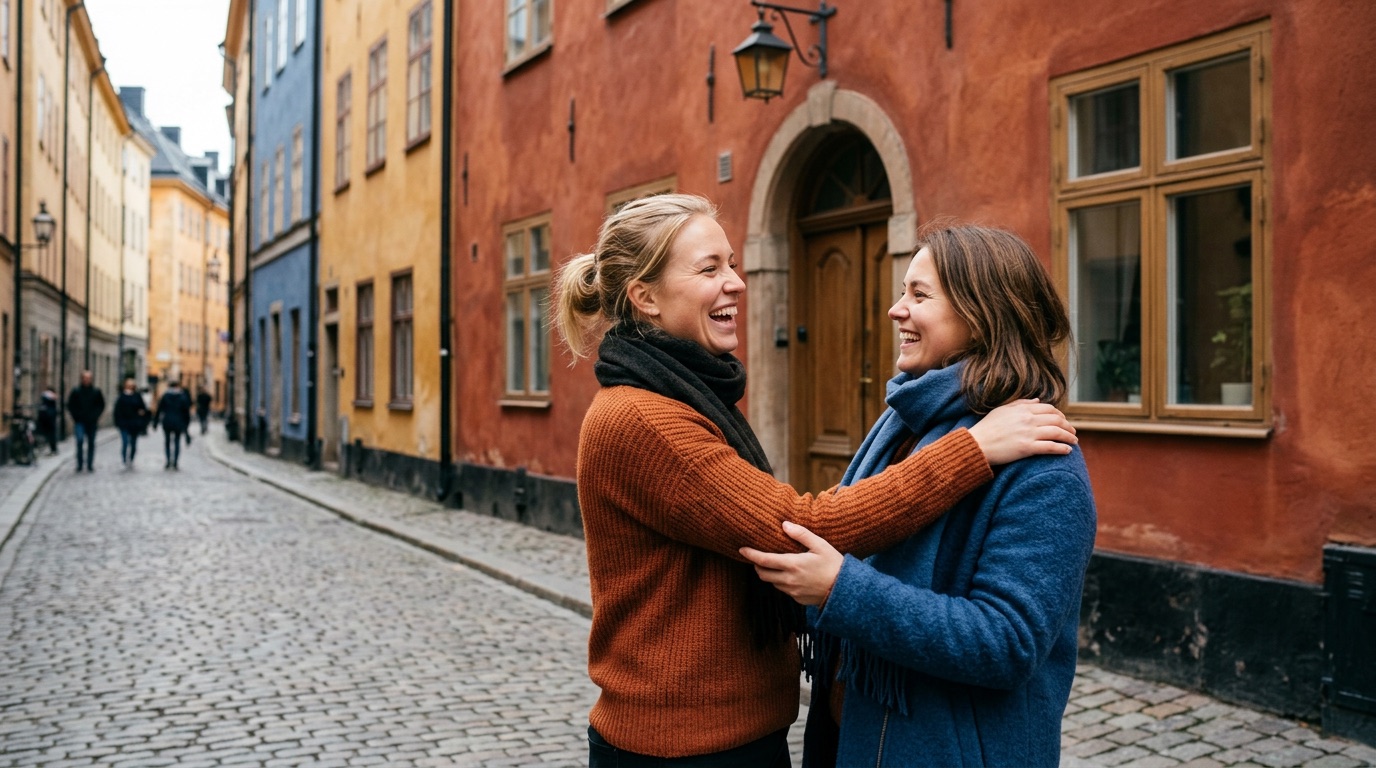
The first thing you learn in any language is how to say hello. In Swedish, greetings are refreshingly simple — the informal hej dominates almost every situation, and the notoriously complex formal address system that other European languages still use was abolished in Sweden decades ago. This guide covers every Swedish greeting, the essential everyday phrases that make up real conversations, and the cultural background that explains why Swedes communicate the way they do.
The Core Swedish Greetings
Swedish has a surprisingly small set of everyday greetings, and once you know them you'll be ready for almost any social situation. Here are all the main ones:
| Swedish | Pronunciation | Meaning / Use |
|---|---|---|
| Hej | hey | Hello — the universal Swedish greeting, casual and semi-formal |
| Hej hej | hey-hey | Goodbye — warm, friendly farewell (NOT a greeting) |
| Tjena | sheh-na | Hey / hi — very casual, among friends and peers |
| Hallå | ha-LOH | Hello — also used to get attention ("Hey!") or answer the phone |
| God morgon | goo MOR-on | Good morning — used until around 10am |
| God dag | goo dahg | Good day — traditional formal greeting, now mostly older speakers |
| God kväll | goo kvell | Good evening — from around 6pm onwards |
| God natt | goo natt | Good night — said when parting for the night or going to bed |
| Hej då | hey doh | Goodbye — the standard farewell |
| Vi ses | vee sehs | See you (later) — casual parting phrase |
| Ha det bra | hah deh brah | Take care / have a good one — warm farewell |
Hej — The One Greeting to Rule Them All
Hej (pronounced exactly like the English word "hey") is used in virtually every context in modern Sweden. You say it to your boss, your grandmother, the cashier at the supermarket, and your best friend. It replaced the more formal god dag in everyday use decades ago and is now the default Swedish greeting at any time of day.
One important note: hej hej (saying "hej" twice) means goodbye, not hello. This trips up many learners. If someone waves and says "hej hej" as they leave the room, they're saying farewell — warmly and casually. You'll hear it constantly in shops, on phone calls, and at the end of casual meetings.
Tjena — The Casual Alternative
Tjena is the equivalent of "hey" or "yo" in English — very casual, used among friends, classmates, and peers of similar age. You might also hear the even more informal tjabo or tjenare. Don't use tjena with someone much older than you or in a professional context — stick to hej there.
The Du Reform: Why Swedish Is Uniquely Informal
Sweden underwent a social revolution in how people address each other. For centuries, Swedish — like French, German, and most European languages — had a formal second-person pronoun (ni) used with strangers, authority figures, and social superiors. Using the informal du with someone above your social station was considered rude.
In the late 1960s and early 1970s, a movement led partly by the Social Democratic government and partly by organic cultural shift swept this system away. Today, du is used universally. Swedes address their Prime Minister, their doctor, the CEO, and the checkout clerk with the same word: du. The formal ni still technically exists but using it today can actually come across as sarcastic or condescending — the opposite of respectful.
For language learners, this is excellent news. You never have to worry about formal vs informal pronouns in Swedish. One word covers every situation.

Essential Everyday Phrases
Beyond greetings, these are the phrases that come up in nearly every Swedish conversation:
| Swedish | Pronunciation | Meaning |
|---|---|---|
| Tack | tahk | Thank you |
| Tack så mycket | tahk soh myk-eh | Thank you very much |
| Varsågod | var-sho-goo | You're welcome / Here you go / Please |
| Förlåt | for-LOHT | Sorry / Excuse me |
| Ursäkta | oor-SEHK-ta | Excuse me (getting someone's attention) |
| Hur mår du? | hoor mor doo | How are you? |
| Bra, tack | brah tahk | Fine, thanks |
| Vad heter du? | vahd heh-ter doo | What is your name? |
| Jag heter... | yahg heh-ter | My name is... |
| Trevligt att träffas | trehv-ligt at tref-as | Nice to meet you |
| Jag förstår inte | yahg for-stor in-teh | I don't understand |
| Kan du upprepa det? | kan doo oop-reh-pah deh | Can you repeat that? |
| Talar du engelska? | tah-lar doo eng-el-ska | Do you speak English? |
| Ja | yah | Yes |
| Nej | nay | No |
Varsågod — The Versatile Word
Varsågod is one of those wonderfully multipurpose Swedish words. It means "you're welcome" after a thank you, "here you go" when handing something to someone, "please go ahead" when holding a door, and "help yourself" when offering food. It comes from the phrase var så god (be so good/kind) and is used constantly in daily Swedish life. Learning to deploy it naturally will immediately make you sound more fluent.
Introducing Yourself in Swedish
A basic self-introduction in Swedish follows a simple formula. Here's a model exchange you can adapt:
- Hej! Jag heter Anna. Vad heter du? — Hi! My name is Anna. What's your name?
- Jag heter Marcus. Trevligt att träffas! — My name is Marcus. Nice to meet you!
- Trevligt att träffas! Var kommer du ifrån? — Nice to meet you! Where are you from?
- Jag kommer från England. Och du? — I'm from England. And you?
- Jag är från Stockholm. — I'm from Stockholm.
Notice the verb heter — this comes from heta (to be called) and is used specifically for names in Swedish, rather than the verb "to be." Swedes say "I am called Marcus" (jag heter Marcus) rather than "I am Marcus" (jag är Marcus), though the latter is also used in informal speech.
Swedish Cultural Notes: Lagom and the Art of Not Over-Greeting
Understanding Swedish greetings goes beyond the words themselves. Swedish culture has some distinctive communication patterns that can surprise people from other cultures:
Lagom — The Swedish Middle Way
Lagom (pronounced LAH-gom) is one of the most famous Swedish words and has no direct English translation. It means something like "just the right amount" — not too much, not too little. This concept pervades Swedish culture, including how people greet and interact. Swedish greetings are warm but measured — you don't typically gush or engage in extended pleasantries with strangers. A genuine hej and a nod is perfectly polite.
Small Talk Is Not a Swedish Strength
Swedes have a reputation — sometimes exaggerated, but not entirely unfounded — for not engaging much in small talk with strangers. Standing in an elevator or waiting at a bus stop, a Swede is unlikely to comment on the weather or start a conversation. This isn't unfriendliness; it's a respect for personal space and a belief that silence isn't awkward. Once you do get into a conversation, Swedes are generally warm, direct, and sincere.
For language learners, this means you may have to initiate conversations more than you would in, say, Spain or Ireland — but when you do, people tend to respond genuinely and helpfully, especially if they can tell you're making an effort to speak Swedish.
Phone Greetings
When answering the phone in Sweden, the most common response is simply to state your name: Hej, det är Anna (Hi, it's Anna). In more formal settings — businesses, customer service — you might hear Hallå followed by the company name and the person's name. Ending a phone call with hej hej is nearly universal.
Seasonal and Occasion-Specific Greetings
Swedish has specific phrases for various occasions and celebrations:
- Grattis! — Congratulations! / Happy Birthday! (used for both)
- Grattis på födelsedagen! — Happy Birthday! (literally: congratulations on the birthday)
- God jul! — Merry Christmas!
- Gott nytt år! — Happy New Year!
- Glad påsk! — Happy Easter!
- Glad midsommar! — Happy Midsummer! (one of Sweden's most important celebrations)
- Skål! — Cheers! (used when toasting drinks — always make eye contact when saying this)
A quick note on Skål: in Swedish toasting etiquette, you raise your glass, make eye contact with each person you're toasting, say skål, drink, and then make eye contact again before lowering your glass. Skipping the eye contact is considered bad form — the tradition is said to date back to times when looking away might mean you were trying to poison someone's drink.
Building Conversations: Useful Response Phrases
Knowing how to respond naturally keeps a conversation flowing. These phrases are the connective tissue of Swedish conversation:
- Verkligen? — Really?
- Precis! — Exactly! / Precisely!
- Självklart — Of course
- Absolut — Absolutely
- Det vet jag inte — I don't know
- Jag håller med — I agree
- Vad intressant! — How interesting!
- Det är bra — That's good
- Inte alls — Not at all
- Kanske — Maybe / Perhaps
Pronunciation Tips for Greetings
A few quick pronunciation notes to make your greetings sound natural:
- Hej: Pronounced exactly like English "hey." The J in Swedish is always a Y sound.
- God: In phrases like god morgon, the final D is typically silent or very soft. It often sounds like "goo morning."
- Tjena: The TJ is a soft hushing sound from the front of the mouth — like "sh" but made further forward. It sounds roughly like "sheh-na."
- Varsågod: This is often run together quickly in natural speech: "var-shaw-goo."
- Förlåt: The Ö is the rounded "er" sound — lips rounded, tongue forward. The Å sounds like the "aw" in British "law."
Ready to practise your Swedish greetings?
SvenskaSpeak gives you 8,000+ words, conversation drills, and real speaking practice — start with the basics and build from there.
Download Free →Frequently Asked Questions
How do you say hello in Swedish?
The most common way to say hello in Swedish is Hej (pronounced like "hey"). It works in almost every situation — casual and semi-formal alike. Among close friends, Tjena (hey/yo) is even more casual. For traditional formal settings, God dag (good day) exists but is now rarely used by younger generations.
What does hej hej mean in Swedish?
Hej hej (also written hejhej) means goodbye in Swedish — not hello. It is a friendly, warm farewell used in casual and even semi-professional settings, like ending a phone call or leaving a shop. Swedes use it constantly and it comes across as cheerful and relaxed. Don't confuse it with a greeting — if someone says "hej hej" as they walk away, they're saying farewell.
Is Swedish formal or informal?
Swedish is famously informal compared to most European languages. The "du reform" of the 1960s and 70s swept away the formal address system — today everyone from colleagues to strangers to the Swedish royals is addressed as du (you). This makes Swedish much simpler to learn than French or German, which still require navigating formal vs informal pronouns. There is one word for "you" in modern conversational Swedish, and it works everywhere.